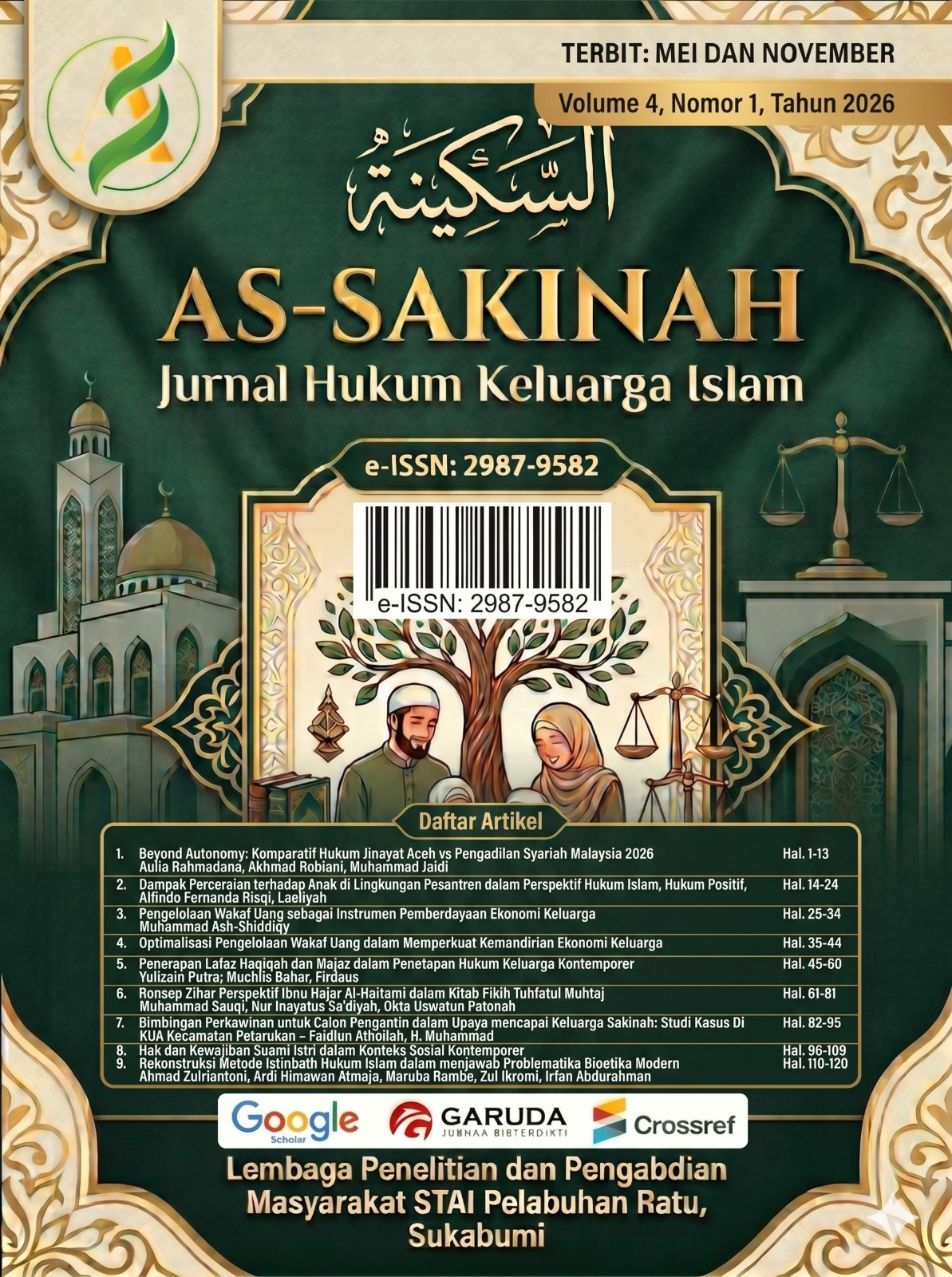
Optimalisasi Pengelolaan Wakaf Uang dalam Memperkuat Kemandirian Ekonomi Keluarga
Kata Kunci:
Wakaf Uang, Bank Wakaf Mikro, Pemberdayaan Ekonomi, Literasi Wakaf, Pengentasan KemiskinanAbstrak
Cash waqf is an Islamic philanthropic instrument with significant potential to promote economic empowerment, particularly at the household level. In Indonesia, the potential of cash waqf is substantial; however, its utilization remains suboptimal due to low public literacy and inadequate management and distribution systems. This study aims to analyze the role of cash waqf management as an instrument for family economic empowerment and to formulate strategies for its optimization. The research employs a qualitative approach with descriptive analysis, using data collected from relevant literature, official documents, and previous studies. The findings indicate that cash waqf has strong potential as a productive financing source to enhance household economic resilience through micro-enterprise development, income generation, and improved access to Islamic financial services. However, its effectiveness depends on the implementation of professional, transparent, and accountable governance, as well as strong institutional support. One promising model is the Micro Waqf Bank (BWM), which functions as a Sharia-based financial intermediary for low-income communities. The presence of BWM expands access to financing, strengthens household business capacity, and reduces dependence on informal lending practices. Therefore, optimizing cash waqf management can serve as an effective instrument for strengthening family economic independence and improving sustainable social welfare.
Unduhan
Referensi
Antonio, M. S., Sanrego, Y. D., & Taufiq, M. (2020). Micro waqf bank: An alternative solution for poverty alleviation in Indonesia. Journal of Islamic Finance, 9(2), 45–60.
Ascarya, & Yumanita, D. (2018). The role of Islamic social finance in poverty alleviation. Al-Iqtishad: Journal of Islamic Economics, 10(1), 1–24.
Ascarya. (2017). Cash waqf and its role in economic development. Bank Indonesia.
Badan Wakaf Indonesia. (2021). Laporan pengelolaan wakaf Indonesia. BWI.
Chapra, M. U. (2008). The Islamic vision of development in the light of maqasid al-Shariah. Islamic Research and Training Institute.
Cizakca, M. (2000). A history of philanthropic foundations: The Islamic world from the seventh century to the present. Boğaziçi University Press.
Creswell, J. W. (2014). Research design: Qualitative, quantitative, and mixed methods approaches (4th ed.). Sage Publications.
Fauzia, A. (2018). Islamic philanthropy and social development in contemporary Indonesia. Journal of Social Studies, 14(1), 1–15.
Haneef, M. A., Pramanik, A. H., Mohammed, M. O., Amin, M. F., & Muhammad, A. D. (2015). Integration of waqf and Islamic microfinance for poverty reduction. International Journal of Islamic Economics, 7(2), 45–60.
Haneef, M. A., Pramanik, A. H., Mohammed, M. O., Amin, M. F., & Muhammad, A. D. (2015). Integration of waqf and Islamic microfinance for poverty reduction. International Journal of Islamic Economics, 7(2), 45–60.
Hasan, Z., & Abdullah, M. N. (2008). The investment of waqf land as an instrument of Muslim’s economic development. Journal of King Abdulaziz University: Islamic Economics, 21(2), 117–134.
Kahf, M. (2003). The role of waqf in improving the ummah welfare. International Seminar on Waqf as a Private Legal Body.
Miles, M. B., Huberman, A. M., & Saldaña, J. (2014). Qualitative data analysis: A methods sourcebook (3rd ed.). Sage Publications.
Otoritas Jasa Keuangan. (2020). Bank Wakaf Mikro dan pemberdayaan ekonomi umat. OJK.
Pitchay, A. A., Meera, A. K. M., & Saleem, M. Y. (2018). Factors influencing the behavioral intentions of Muslim employees to contribute to cash-waqf. Journal of Islamic Accounting and Business Research, 9(3), 297–314.
Rahman, A. A., Alias, M. H., & Omar, S. M. N. S. (2020). Waqf digitalization: Opportunities and challenges. Journal of Islamic Finance, 9(1), 12–25.
Raimi, L., Patel, A., & Adelopo, I. (2014). Corporate social responsibility, waqf system and zakat system as faith-based model for poverty reduction. World Journal of Entrepreneurship, Management and Sustainable Development, 10(3), 228–242.
Rozalinda. (2015). Manajemen wakaf produktif. Rajawali Pers.
Rusydiana, A. S., & Devi, A. (2017). Analisis pengelolaan wakaf di Indonesia. Jurnal Ekonomi dan Keuangan Islam, 3(2), 45–59.
Sugiyono. (2017). Metode penelitian kualitatif, kuantitatif, dan R&D. Alfabeta.
Zed, M. (2014). Metode penelitian kepustakaan. Yayasan Obor Indonesia.
Unduhan
Diterbitkan
Cara Mengutip
Terbitan
Bagian
Lisensi
Hak Cipta (c) 2026 Laila Nurmilah

Artikel ini berlisensi Creative Commons Attribution 4.0 International License.
Authors who publish with this journal agree to the following terms:
- Authors retain copyright and grant the journal right of first publication with the work simultaneously licensed under a Creative Commons Attribution 4.0 International License. that allows others to share the work with an acknowledgement of the work's authorship and initial publication in this journal.
- Authors are able to enter into separate, additional contractual arrangements for the non-exclusive distribution of the journal's published version of the work (e.g., post it to an institutional repository or publish it in a book), with an acknowledgement of its initial publication in this journal.
- Authors are permitted and encouraged to post their work online (e.g., in institutional repositories or on their website) prior to and during the submission process, as it can lead to productive exchanges, as well as earlier and greater citation of published work.