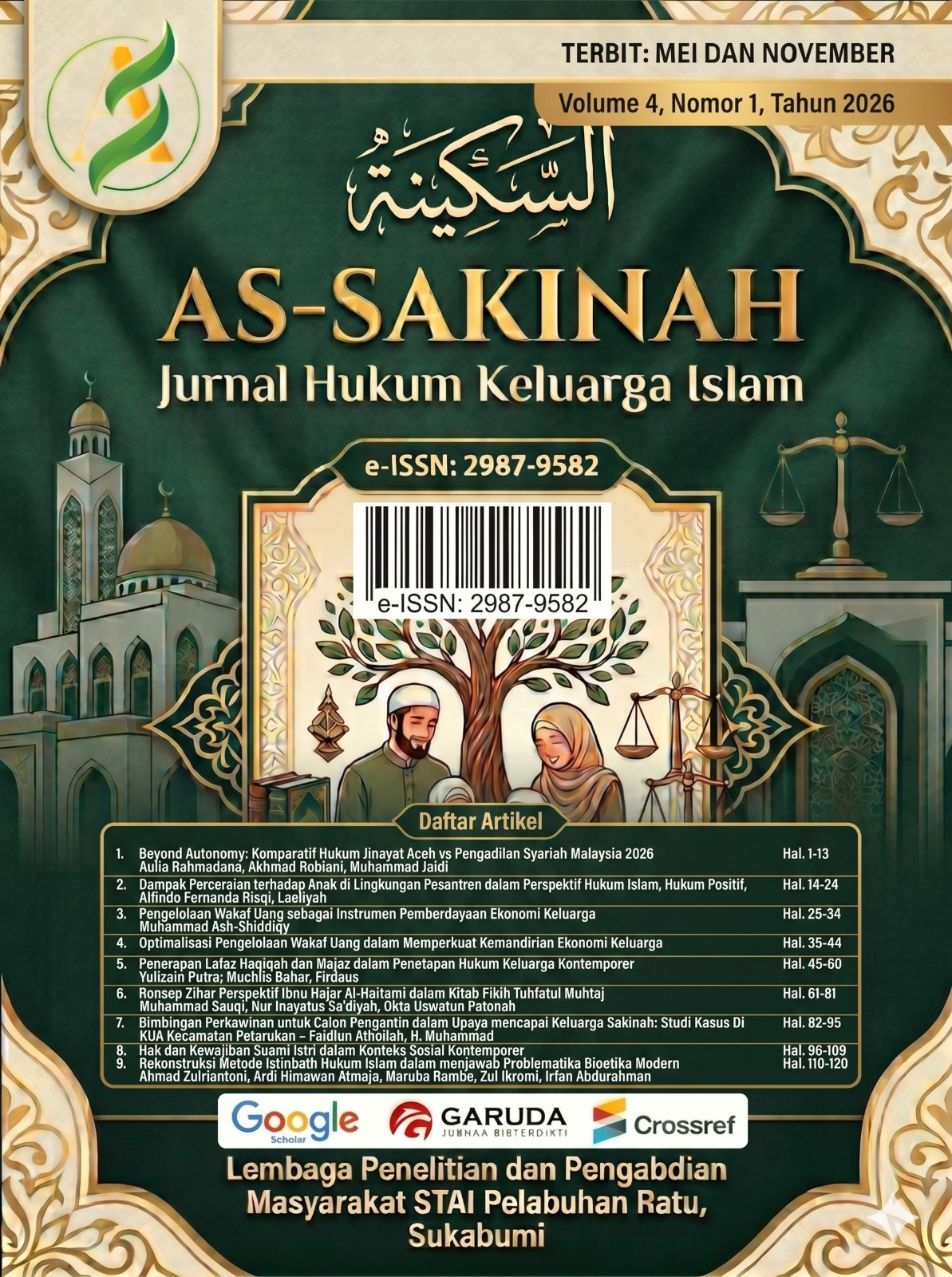
Konsep Zihar Perspektif Ibnu Hajar Al-Haitami dalam Kitab Fikih Tuhfatul Muhtaj
DOI:
https://doi.org/10.51729/sakinah412067Kata Kunci:
Ibnu Hajar Al-Haitami, Zihar, Tuhfatul MuhtajAbstrak
This research discusses the concept of zihar from the perspective of Ibn Hajar Al-Haitami, as explained in the fiqh book Tuhfatul Muhtaj. The aim of this research is to understand what is meant by zihar according to Ibnu Hajar Al-Haitami's view, how the law applies, and how this affects the relationship between husband and wife in Islamic family law. This research uses qualitative methods with a normative and doctrinal approach, through text analysis of primary sources and literature studies from various Shafi'i school of jurisprudence literature. Research shows that zihar is considered a statement that has serious legal consequences, even though it does not directly end a marriage. Ibnu Hajar Al-Haitami stated that kafarat is a necessity that must be carried out as a way to restore the relationship between husband and wife and as a means of protecting women's dignity. The results of this research show that the concept of zihar in the sense of Shafi'i jurisprudence is not only an established rule, but also reflects the principles of justice, politeness in speaking, and protection of family rights in the Islamic legal system.
Unduhan
Referensi
Aminah, S. (2021). Zihar Dalam Al- Qur’an (Analisis Hermeneutika Hassan Hanafi). Institut Agama Islam Negeri (Iain) Curup.
Azhari, E. (2022). Pemikiran Imam Ibnu H Ajar Al-H Aitami Dalam Kitab Tuh Fatul Muh Ta J Dan Relevansinya Dengan Pengembangan Akad Pada Bank Syari‘Ah ( Murabah Ah , Mud Arabah , Musharakah) Oleh. Universitas Islam Negeri Mataram.
Damanik, W. H., Adly, M. A., & Firmansyah, H. (2024). Kaidah Yang Berkaitan Dengan Zhihar. Budi Pekerti Agama Islam, 2(5), 3.
Hajar, A. I. M. I. ‘Ali I. H. Al-H. I. (2000). Tuhfah Al-Muhtaj Fi Syarh Al-Minhaj (Juz Viii). Beirut: Dar Al-Fikr.
Harfiati, N. Z., Aprianti, F., & Patuti, A. (2026). Batasan Interaksi Suami-Istri Dan Konsekuensi Hukumnya Dalam Kasus Zihar (Analisis Perbandingan Mazhab). Al-Muntaqa: Jurnal Studi Islam Dan Bahasa Arab, 2(1), 223. Https://Doi.Org/10.36701/Muntaqa.V2i1.2454
Hayati, L. (2026). Konsep Iddah Bermasuk-Masukkan Dalam Kitab An-. Biti Jannati : Jurnal Hukum Kelurga Islam, 3(1), 2.
Hilmi, S., Yeoh, M. S., Ghaddafi, M., & Mahwati, R. (2019). Pengaruh Ibn Hajar Al-Haitami Dalam Muamalat Kitab Mir ’ At Al -Thullab. 5.
Hito, M. (2023). Hadits Tentang Li’an, Ila’ Dan Dzihar.
Huda, N. (2020). Terjemah Kitab Al-Mahalli Jilid 4. Darussolah.
Isrofiyah, S. (2018). Analisis Ayat Tentang Larangan Melemah- Lembutkan Suara Bagi Wanita Dalam Qs. Al Ahzab Ayat 32 (Studi Komparatif Tafsir Al Misbah Dan Tafsir Hamka). Universitas Islam Negri Walisongo.
Jnz, R. F. A. (2024). Pemikiran Pendidikan Anak Dalam Perspektif Ibnu Hajar. Attaqwa: Jurnal Pendidikan Islam Dan Anak Usia Dini, 3(2), 70–71.
Mahrus, A. K. (2014). Terjemah Fathul Qorib Juz 2 (Cet 1). Santri Salaf Press.
Munandar, A., & Djuned, M. (2018). Zihar Dalam Tafsir Fi Zhilal Al-Qur’an Dan Tafsir Al-Mishbah Arif. Journal Of Qur’anic Studies, 3(1), 18.
Q.S Al-Mujadalah Ayat 1.
Ridwan, A., Saude, S., & Rusdin, R. (2022). Konsep Zhihar Dalam Pandangan Hukum Islam. Dalam Prosiding Konferensi Internasional Ilmu-Ilmu Sosial (Kiiies), 1(1), 324.
Rohimin, M., Silviyani, E., & Fithoroini, D. (2026). Telaah Ushul Fikih Terhadap Penentuan ‘ Illah Pada Kasus Ẓihār Dalam Rumah Tangga Modern. Sedanten Jurnal Multidisiplin Ilmu, 1(1), 58.
Simanjuntak, H., Adly, M. A., & Firmansyah, H. (2024). Qawaid Fiqhiyyah Tentang Zihar. Jurnal Budi Pekerti Agama Islam, 2(5), 188.
Wafa, M. A. (2018). Hukum Perkawinan Di Indonesia. Yasmi (Yayasan Asy-Syari’ah Modern Indonesia).
Yulianto. (2018). Konsep Pendidikan Anak Dalam Perspektif Ibnu Hajar Al- Haitami (Ragam Eksplorasi Kitab Tahrīru Al-Maqōl Fī Adābi Wa Ahkāmi Wa Fawā’idu Yahtāju Ilaihā Muˋaddibū Al-Aṭfāl) Yulianto. Al- Mudarris : Journal Of Education, 1(1), 46.
Unduhan
Diterbitkan
Cara Mengutip
Terbitan
Bagian
Lisensi
Hak Cipta (c) 2026 Muhammad Sauqi, Nur Inayatus Sa’diyah, Okta Uswatun Patonah

Artikel ini berlisensi Creative Commons Attribution 4.0 International License.
Authors who publish with this journal agree to the following terms:
- Authors retain copyright and grant the journal right of first publication with the work simultaneously licensed under a Creative Commons Attribution 4.0 International License. that allows others to share the work with an acknowledgement of the work's authorship and initial publication in this journal.
- Authors are able to enter into separate, additional contractual arrangements for the non-exclusive distribution of the journal's published version of the work (e.g., post it to an institutional repository or publish it in a book), with an acknowledgement of its initial publication in this journal.
- Authors are permitted and encouraged to post their work online (e.g., in institutional repositories or on their website) prior to and during the submission process, as it can lead to productive exchanges, as well as earlier and greater citation of published work.