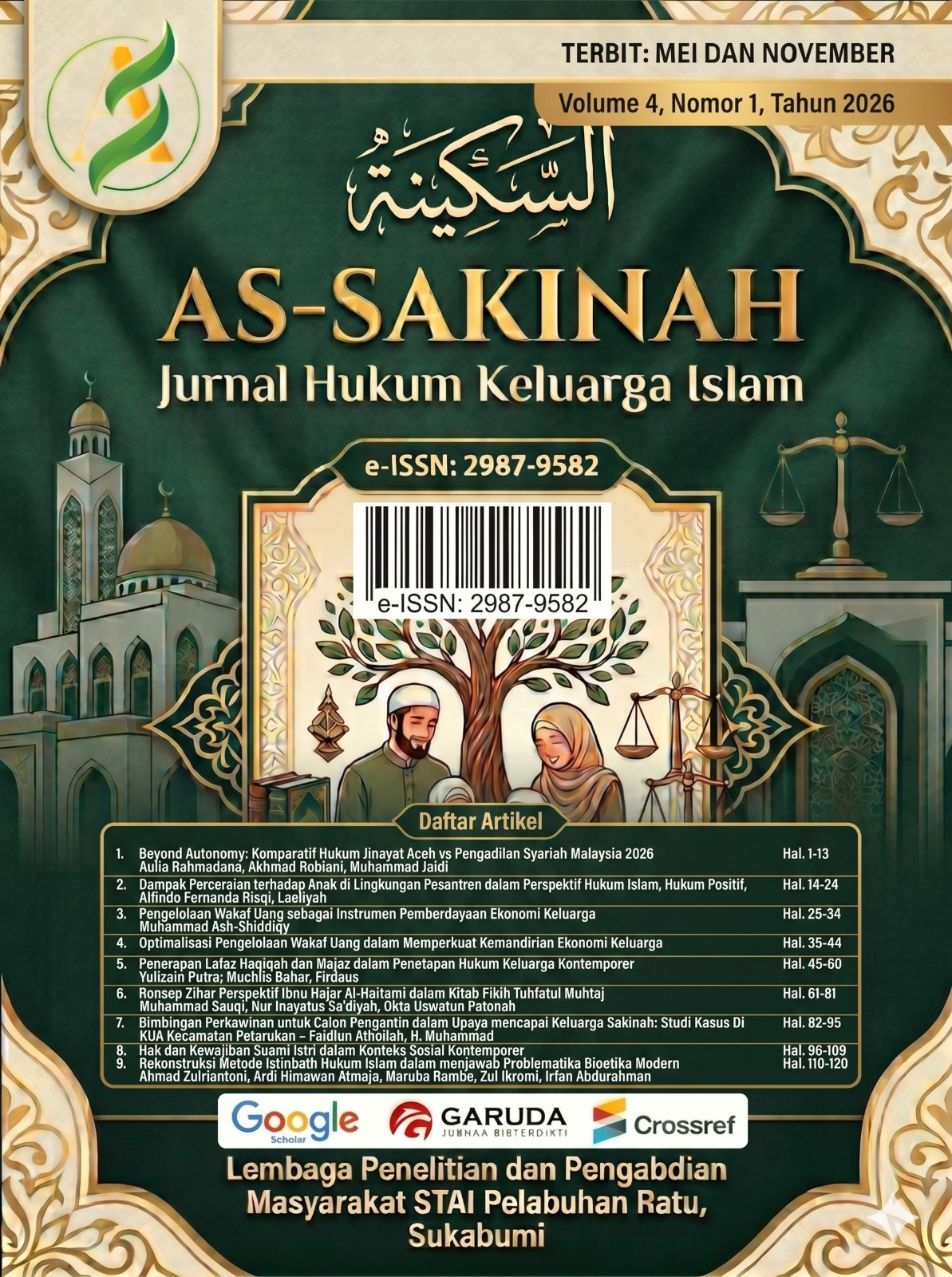
Rekonstruksi Metode Istinbath Hukum Islam dalam menjawab Problematika Bioetika Modern
DOI:
https://doi.org/10.51729/sakinah412100Kata Kunci:
Rekonstruksi Istinbath, Bioetika Modern, Maqasid asy-Syari'ah, Skema TransdisiplinerAbstrak
The rapid advancement of modern biotechnology—such as genome editing (CRISPR-Cas9), stem cell research, and end-of-life decisions—has placed Islamic law in a dilemmatic position between accelerating medical benefits and maintaining ethical-moral boundaries. This study aims to analyze the methodological limitations of conventional istinbath al-ahkam in responding to modern bioethical dilemmas, while simultaneously offering a solid model for reconstructing legal reasoning. This study is a normative-philosophical legal research using conceptual and philosophical approaches. The findings reveal that the mainstream istinbath methods, which are heavily dominated by textual-linguistic approaches (bayani) and linear analogy (qiyas), tend to experience epistemological stagnation. They often produce reactive and restrictive fatwas because they isolate legal texts from the reality of science. To overcome this deadlock, this study formulates a reconstruction model called the Transdisciplinary Hybrid Scheme. This scheme integrates the five basic principles of contemporary Maqasid asy-Syari'ah with four international biomedical ethics principles (autonomy, beneficence, non-maleficence, and justice). Through this hybrid scheme, the process of legal discovery moves beyond the boundaries of jurists and scientists across three systematic stages: clinical verification (tahqiq al-manat), maqasidi-bioethics filtration test, and the formulation of inclusive conditional rulings. This reconstruction proves that Islamic law is capable of providing progressive moral-legal certainty for future scientific disruptions without losing the spiritual roots of Sharia.
Unduhan
Referensi
Auda, Jasser. 2021. Re-Envisioning Islamic Law: Maqasid as-Shariah as a Philosophy of Islamic Law. London: International Institute of Islamic Thought.
Beauchamp, Tom L., dan James F. Childress. 2019. Principles of Biomedical Ethics. Edisi ke-8. New York: Oxford University Press.
Ibrahim, Johnny. 2013. Teori dan Metodologi Penelitian Hukum Normatif. Cet. 4. Malang: Bayumedia Publishing.
Marzuki, Peter Mahmud. 2017. Penelitian Hukum: Edisi Revisi. Cet. 13. Jakarta: Kencana.
Soekanto, Soerjono, dan Sri Mamudji. 2015. Penelitian Hukum Normatif: Suatu Tinjauan Singkat. Cet. 17. Jakarta: Rajawali Pers.
Syarifuddin, Amir. 2018. Ushul Fiqh: Jilid 1. Jakarta: Kencana.
Zayd, Nasr Hamid Abu. 2022. Tekstualitas Al-Qur'an: Kritik Terhadap Epistemologi Hukum Islam. Terjemahan. Yogyakarta: LKiS.
Ghonim, Ahmed. 2023. "Genomic Editing in Islamic Jurisprudence: A Substantive Maqasidi Approach." International Journal of Shariah and Bio-Science 4, no. 3: 102-120.
Kamali, Mohammad Hashim. 2022. "Islam and Bioethics: Framing the Modern Dilemmas." Journal of Islamic Medical Ethics 6, no. 1: 38-52.
Mooney, Claire. 2021. "Stem Cell Research and Bioethics in Contemporary Religious Laws." Medical Law and Ethics Review 9, no. 2: 60-78.
Rofiq, Ahmad. 2024. "Metode Istinbath Hukum Kontemporer: Telaah atas Pendekatan Maqasidiy Jasser Auda." Jurnal Ushuluddin dan Hukum 10, no. 2: 198-215.
Unduhan
Diterbitkan
Cara Mengutip
Terbitan
Bagian
Lisensi
Hak Cipta (c) 2026 Ahmad Zulriantoni, Ardi Himawan Atmaja, Maruba Rambe, Zul Ikromi, Irfan Abdurahman

Artikel ini berlisensi Creative Commons Attribution 4.0 International License.
Authors who publish with this journal agree to the following terms:
- Authors retain copyright and grant the journal right of first publication with the work simultaneously licensed under a Creative Commons Attribution 4.0 International License. that allows others to share the work with an acknowledgement of the work's authorship and initial publication in this journal.
- Authors are able to enter into separate, additional contractual arrangements for the non-exclusive distribution of the journal's published version of the work (e.g., post it to an institutional repository or publish it in a book), with an acknowledgement of its initial publication in this journal.
- Authors are permitted and encouraged to post their work online (e.g., in institutional repositories or on their website) prior to and during the submission process, as it can lead to productive exchanges, as well as earlier and greater citation of published work.