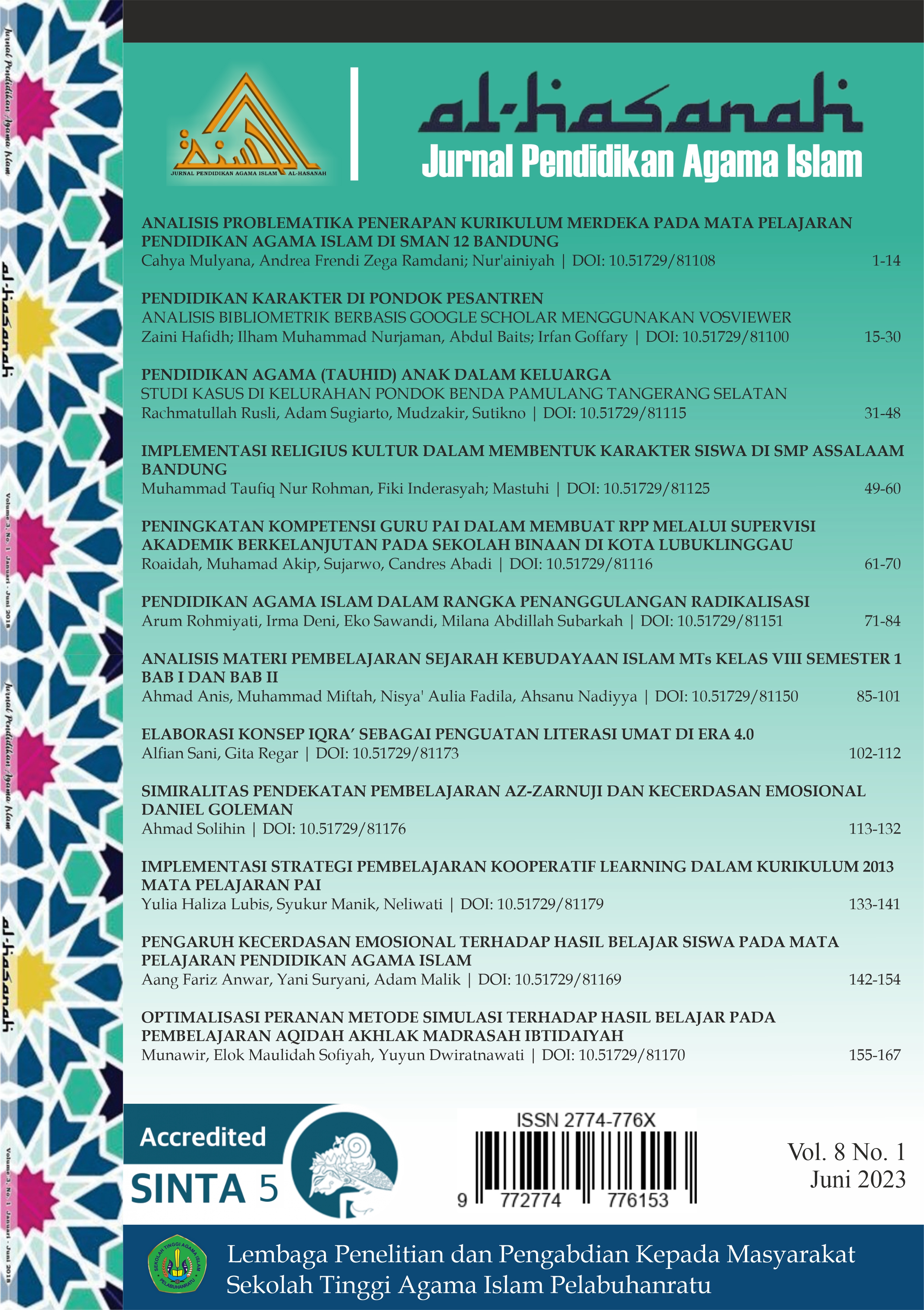
ANALISIS PROBLEMATIKA PENERAPAN KURIKULUM MERDEKA PADA MATA PELAJARAN PENDIDIKAN AGAMA ISLAM DI SMAN 12 BANDUNG
DOI:
https://doi.org/10.51729/81108Keywords:
Independent Curriculum, Education, ProblemsAbstract
The development of the era is so rapid, making technology has become part of people's lives. The world of education is no exception, which is increasingly demanded to be able to adapt to the times. Education in the era of society 5.0, which is very closely related to 21st century skills, inspired the Indonesian government to present a new breakthrough curriculum, namely the independent learning curriculum. This also has an effect on concepts and learning systems that are more advanced and flexible, thus demanding all elements of the school to continue to develop and adapt, especially to Islamic Religious Education subjects. The purpose of writing this article is to describe and analyze the problems of implementing the independent curriculum in the subject of Islamic Religious Education at SMAN 12 Bandung. This approach uses qualitative methods, through a phenomenological approach. The results of this study state that the implementation of the Independent Curriculum in schools still faces various problems, especially in the aspects of teachers, students, and infrastructure. This is evidenced by the effectiveness of the learning concept of the Independent Curriculum which has not been maximized.
Downloads
References
Afifah, S. N. (2020). PROBLEMATIKA PENERAPAN KURIKULUM MERDEKA DALAM MATA PELAJARAN PENDIDIKAN AGAMA ISLAM DI SMP AL-FALAH DELTASARI SIDOARJO. Suparyanto dan Rosad (2015, 5(3), 248–253.
Asrul, Ananda, R., & Rosinta. (2014). Evaluasi Pembajalaran. In Ciptapustaka Media.
Fatmawati, & Yuzrizal. (2020). Peran Kurikulum Akhlak Dalam Pembentukan Karakter Di Sekolah Alam Sou Parung Bogor. Tematik Universitas Negeri Medan, 11(1), 26–36. https://jurnal.unimed.ac.id/2012/
Fauzi, A. (2022). Implementasi Kurikulum Merdeka Di Sekolah Penggerak. Pahlawan: Jurnal Pendidikan-Sosial-Budaya, 18(2), 18–22. https://doi.org/10.57216/pah.v18i2.480
Freire, P. (2011). Pendidikan Kaum Tertindas. LP3ES.
Kamal, I., Firmansyah, E. A., Rafiah, K. K., Rahmawan, A. F., & Rejito, C. (2020). Pembelajaran di Era 5.0. November, 265–276.
Kemdikbud. (2020). Kepmendikbud Nomor 719/P/2020 tentang Pedoman Pelaksanaan Kurikulum pada Satuan Pendidikan dalam Kondisi Khusus. Www.Kemdikbud.Go.Id, 022651, 9. https://www.kemdikbud.go.id/main/blog/2020/08/kemendikbud-terbitkan-kurikulum-darurat-pada-satuan-pendidikan-dalam-kondisi-khusus
Menteri Pendidikan, Kebudayaan, R. dan T. (2022). Salinan Keputusan Menteri Pendidikan, Kebudayaan, Riset dan Teknologi Republik Indonesia Nomor 56/M/2022 tentang Pedoman Penerapan Kurikulum dalam Rangka Pemulihan Pembelajaran.
Ningrum, A. S. (2022). Pengembangan Perangkat PembelajaranNingrum, A. S. (2022) ‘Pengembangan Perangkat Pembelajaran Kurikulum Merdeka Belajar ( Metode Belajar )’, in PROSIDING PENDIDIKAN DASAR, pp. 166–177. doi: 10.34007/ppd.v1i1.186. Kurikulum Merdeka Belajar ( Metode Belajar. Prosiding Pendidikan Dasar, 1, 166–177. https://doi.org/10.34007/ppd.v1i1.186
Ruhimat, T. (2010). Prosedur Pembelajaran. Universitas Pendidikan Indonesia, h. 6-7.
Sabriadi, H. R., & Wakia, N. (2021). Problematika Implementasi Kurikulum Merdeka Belajar di Perguruan Tinggi. Adaara: Jurnal Manajemen …, 11(2), 175–184. https://www.jurnal.iain-bone.ac.id/index.php/adara/article/view/2149%0Ahttps://www.jurnal.iain-bone.ac.id/index.php/adara/article/download/2149/1043
Simanjuntak, P. (2005). Manajemen & Evaluasi Kinerja. FE UI.
Subiono. (2012). Hypnometafisika (1 ed.). Deepublish.
Sugiman. (2021). Penguatan Pembelajaran dan Penilaian yang bermuatan 4C Competence in Mathematics di Era “Merdeka Belajar” pada Guru-guru SMPN 24 Semarang.
Zuhairini, H., Abdul, G., & Yusuf, S. A. (1977). Methodik Khusus Pendidikan Agama. Biro Ilmiah Fakultas Tarbiyah IAIN Sunan Ampel.
Downloads
Published
How to Cite
Issue
Section
License
Copyright (c) 2023 Cahya Mulyana, Andrea Frendi Zega Ramdani; Nur'ainiyah

This work is licensed under a Creative Commons Attribution 4.0 International License.
Authors who publish with this journal agree to the following terms:
- Authors retain copyright and grant the journal right of first publication with the work simultaneously licensed under a Creative Commons Attribution 4.0 International License. that allows others to share the work with an acknowledgement of the work's authorship and initial publication in this journal.
- Authors are able to enter into separate, additional contractual arrangements for the non-exclusive distribution of the journal's published version of the work (e.g., post it to an institutional repository or publish it in a book), with an acknowledgement of its initial publication in this journal.
- Authors are permitted and encouraged to post their work online (e.g., in institutional repositories or on their website) prior to and during the submission process, as it can lead to productive exchanges, as well as earlier and greater citation of published work.