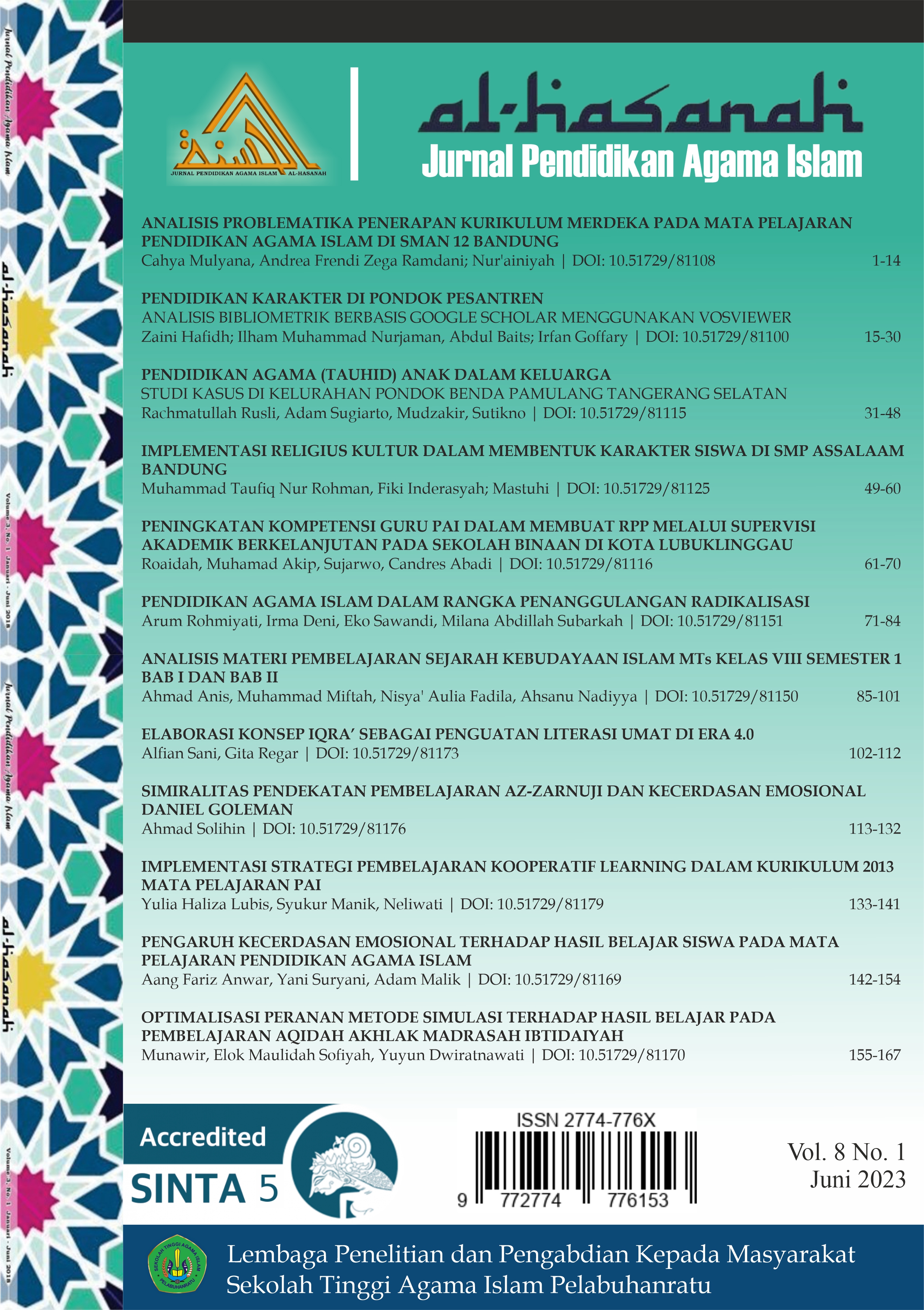
PENGARUH KECERDASAN EMOSIONAL TERHADAP HASIL BELAJAR SISWA PADA MATA PELAJARAN PENDIDIKAN AGAMA ISLAM
DOI:
https://doi.org/10.51729/81169Keywords:
Emotional Intelligence (EQ), Learning Outcomes, Islamic educationAbstract
͞So far, many people think that achieving academic success is a challenge. High intelligence requires high intellectual intelligence (IQ). other factors that influence One of them is emotional intelligence. Emotional intelligence is a person's ability to recognize his own emotions, control them, be motivated, recognize the feelings of others and train the ability to relate to others. While learning outcomes are learning achievements from a learning activity that is carried out based on measurement and assessment of the results of learning activities in the academic field which are manifested in the form of numbers in report cards. The method used in this research is quantitative with a total sample of 32 students from class VII A SMP IT Annibras. The purpose of this study was to determine the extent to which emotional intelligence influences student learning outcomes in PAI subjects, which will later become a reference for schools in efforts to improve student learning outcomes. The Emotional Intelligence of class VII students at SMP IT Annibras is in a very high classification with a percentage of 92.1% as well as student learning outcomes in Islamic Religious Education subjects which are also very high with a percentage of 86.8%. The correlation is 70.6% with the hypothesis that there is a relationship between Emotional Intelligence and student PAI learning outcomes in the strong correlation classification, the effect is also 50% with the statement that Emotional Intelligence influences student PAI Learning Outcomes, in the sense that student PAI learning outcomes are influenced 50% by intelligence emotional and 50% beyond emotional intelligence
Downloads
References
Amirullah. (2015). Populasi dan Sampel. 68.
Carter, P. (2010). Soft Competencies: Cetakan Pertama. Jakarta: PPM Manajemen.
CHANG, C.-P. H.-Y. (2017). John W. Creswell, Research Design: Qualitative, Quantitative, and Mixed Methods Approaches, Sage,. Journal Of Social and Administrative Sciences, 209.
Creswell, J. W. (2008). Educational Research, Planning, Conducting, adn Evaluating Quantitative and Qualitative Reasearch. USA: Pearson Education Inc.
Djamarah, S. B. (1994). Prestasi Belajar dan Kompetensi Guru. Surabaya: Usaha Nasional.
Ginanjar, A. (2009). ESQ Power : Edisi Pertama. Jakarta: Arga Publishing.
Maryana Kuswandi Jaya, D. M. (2012). Pengaruh Kecerdasan Emosional Terhadap Kinerja Karyawan . Jurnal Manajemen, 1038-1039.
Naresh K Malhotra, J. A. (1996). Methodological issues in cross‐cultural marketing research: A state‐of‐the‐art review. MCB UP Ltd, 4.
Slameto. (2010). Belajar dan Faktor-Faktor Yang Mempengaruhinya. Jakarta: Rineka Cipta.
Sugiyono. (2007). Metodelogi Penelitian Administrasi. Jakarta: Grafindo.
Thaib, E. N. (2013). Hubungan Antara Prestasi Belajar dengan Kecerdasan Emosional. Jurnal Ilmiah DIDAKTIKA, 395-396.
Downloads
Published
How to Cite
Issue
Section
License
Copyright (c) 2023 Aang Fariz Anwar, Yani Suryani, Adam Malik

This work is licensed under a Creative Commons Attribution 4.0 International License.
Authors who publish with this journal agree to the following terms:
- Authors retain copyright and grant the journal right of first publication with the work simultaneously licensed under a Creative Commons Attribution 4.0 International License. that allows others to share the work with an acknowledgement of the work's authorship and initial publication in this journal.
- Authors are able to enter into separate, additional contractual arrangements for the non-exclusive distribution of the journal's published version of the work (e.g., post it to an institutional repository or publish it in a book), with an acknowledgement of its initial publication in this journal.
- Authors are permitted and encouraged to post their work online (e.g., in institutional repositories or on their website) prior to and during the submission process, as it can lead to productive exchanges, as well as earlier and greater citation of published work.